

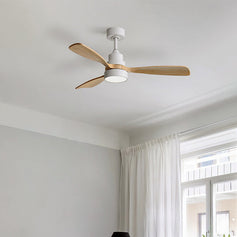
Ceiling Fan Height Guide: Low Ceilings, High Ceilings and Sloped Ceilings

Ceiling height determines how a fan should be mounted. Low ceilings need a compact installation; high ceilings may need a longer downrod; sloped ceilings require compatible mounting hardware.
Whether you need a ceiling fan with light and remote control or a fan without lighting, start with clearance, then check airflow and everyday functions.
1. Measure the Right Heights
Record these three measurements:
- Ceiling height: floor to ceiling at the installation point.
- Blade drop: ceiling to the lowest part of the blades.
- Total installed drop: ceiling to the lowest part of the complete fan, including its light.
Use at least 2.3 m between the floor and exposed blades as a planning minimum. Follow the product manual and applicable local requirements wherever they require greater clearance.
Blade height = ceiling height − blade drop
For example, a 2.6 m ceiling with a 25 cm blade drop leaves 2.35 m beneath the blades. Check the light fitting’s lower edge separately.
2. Low Ceilings: Keep the Installation Compact
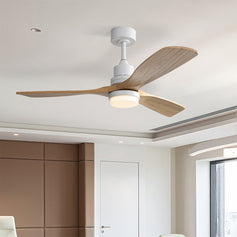
A flush-mount ceiling fan, also called a low-profile or hugger fan, sits close to a flat ceiling without a visible downrod. This reduces the installed drop.

Check the actual dimensions rather than relying on “low profile” in the name.
With a 2.5 m ceiling, a 2.3 m blade-height requirement allows no more than 20 cm from the ceiling to the lowest blade point. A flush-mount design does not automatically meet this limit.
Do not remove a downrod or change the mounting arrangement unless the manufacturer explicitly permits it. The specified clearance above the blades must also remain available.
3. High Ceilings: Bring Airflow Closer
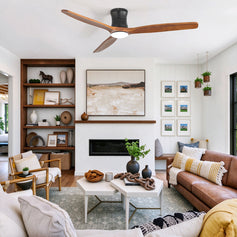
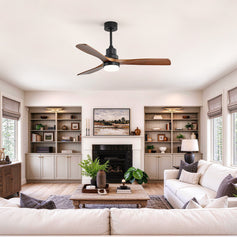
A downrod suspends the fan below the ceiling. In taller rooms, an approved extension downrod can position the blades closer to the occupied area while maintaining the required clearance.

Calculate the required assembled drop first:
Required blade drop = ceiling height − planned blade height
Then check which approved downrod produces that installed dimension. Downrod length alone is not the total blade drop: the canopy, mounting connections and motor assembly also contribute.
Confirm rod compatibility, fixing connections and available wiring length. Room area in m², fan diameter in cm and airflow in m³/h still matter; ceiling height alone does not determine fan size.
4. Sloped Ceilings: Keep the Fan Level
A sloped ceiling needs a fan and mounting system approved for the measured angle. Having a downrod does not automatically make a fan suitable.

Check four points:
- Slope limit: the ceiling angle is within the model’s stated allowance.
- Mounting hardware: the supplied canopy or an approved adapter supports that angle.
- Blade clearance: the full blade sweep clears the descending ceiling, beams and nearby objects.
- Floor clearance: sufficient height remains beneath the blades and light.
The downrod should hang vertically, with the blade rotation plane horizontal. A longer rod may provide additional roof clearance, but it must also preserve floor clearance. Flush-mount fans generally require a flat ceiling unless expressly approved otherwise.
Illustrative installation only; confirm the specific fan’s slope approval and required accessories.
5. Check Lighting, Control and Comfort Functions
Mounting type does not establish which functions are included. Check these separately.
| Función | Qué comprobar |
|---|---|
| Motor y velocidades | Motor DC, velocidades regulables, potencia consumida en W y funcionamiento suave a baja velocidad. |
| Caudal de aire y nivel sonoro | Caudal de aire en m³/h y nivel sonoro medido en dB(A), con indicación de la velocidad de funcionamiento. |
| Iluminación LED | En un ventilador de techo con luz, comprobar el flujo luminoso en lúmenes, la temperatura de color en kelvin, la regulación del brillo y el control independiente del ventilador y la luz. |
| Mando a distancia | Qué funciones de velocidad, iluminación, temporizador e inversión del sentido de giro se pueden manejar desde el suelo. |
| Función de memoria | Qué ajustes de brillo, temperatura de color o velocidad se conservan tras usar el mando a distancia o el interruptor de pared. |
| Modos verano e invierno | Sentido de giro reversible para una brisa refrescante en verano y una circulación suave del aire en invierno. |
| Temporizador, modos sueño y brisa | Tiempos de apagado disponibles y cambios automáticos de velocidad, si se incluyen. |
| Control mediante app y por voz | Aplicaciones compatibles, requisitos Wi-Fi y compatibilidad con Alexa o Google Assistant, si están disponibles. |
| Controles de pared | Comprobar los interruptores y dispositivos de control autorizados. Utilizar un regulador de pared solo si se admite expresamente. |
6. Before Installation
Confirm structural support, suitable fixings, electrical compatibility and access for maintenance with a qualified installer. A suspended plasterboard ceiling or an existing light fitting’s fixing point should not be assumed suitable for supporting a rotating fan.
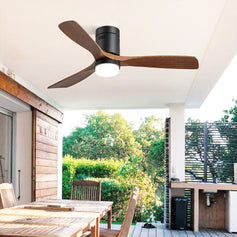
Keep the blade sweep clear of doors, cupboards, bunk beds and raised platforms. For covered outdoor locations, verify the manufacturer’s location approval and appropriate IP rating.


