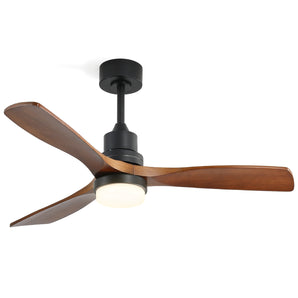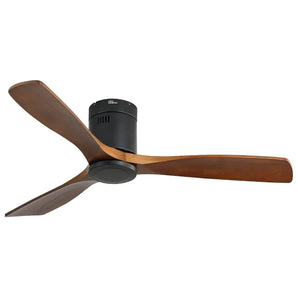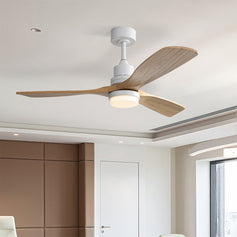
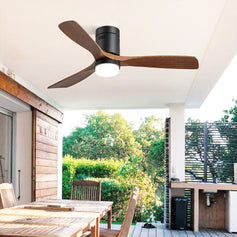

What Size Ceiling Fan Do You Need? A Guide in m² and cm
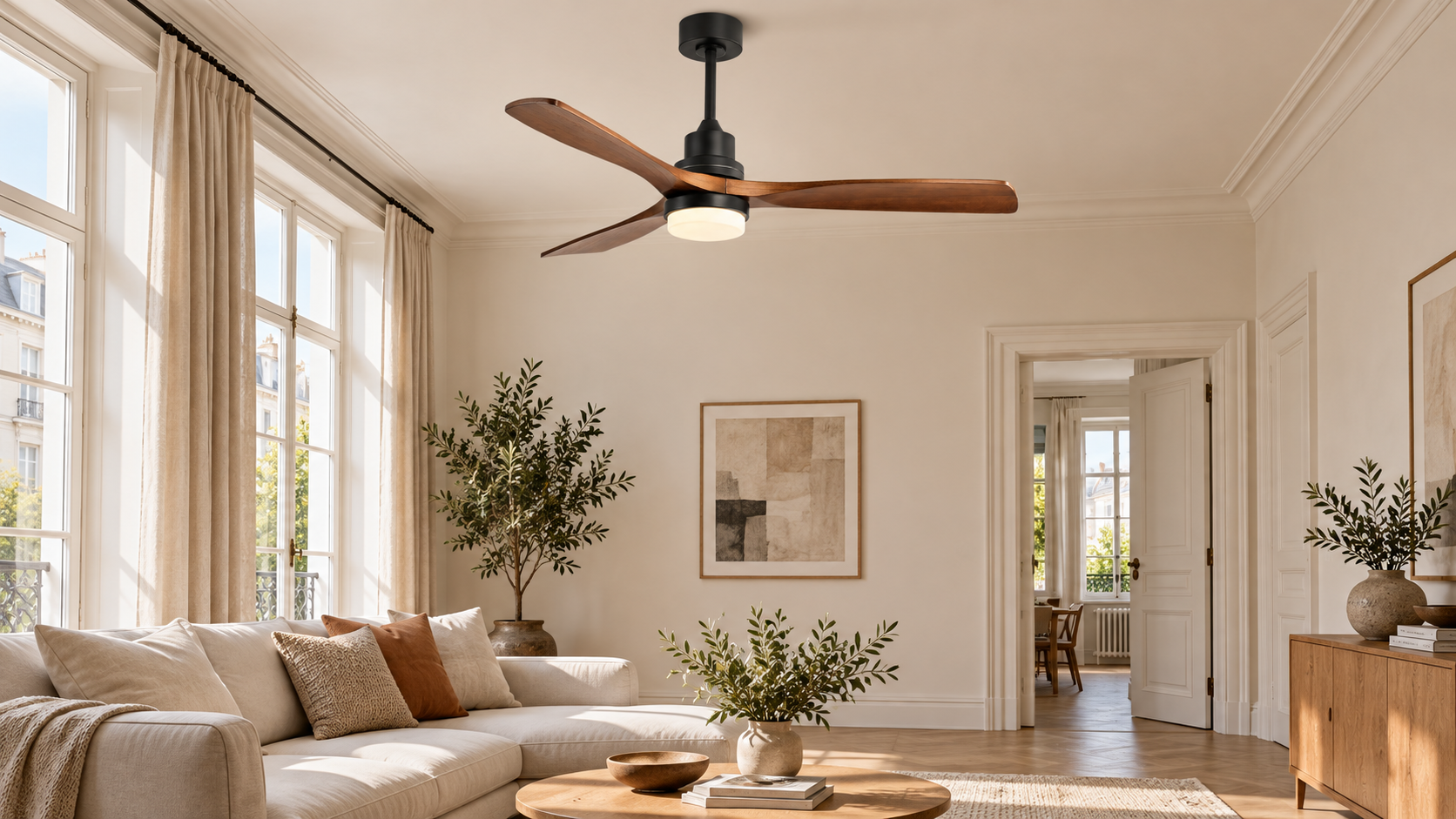
The right ceiling fan size depends on your room’s floor area, ceiling height and layout. Start with the blade diameter, then check airflow and installation clearances. If you need a ceiling fan with light and remote control, assess lighting and control functions separately from fan size.
1. Measure Your Room
Multiply the room’s length by its width:
- Room area (m²) = length (m) × width (m)
- A room measuring 4 m × 5 m has a floor area of 20 m².
For an L-shaped room, measure each section separately. In an open-plan space, identify the areas where you need airflow, such as the seating and dining zones.
2. Match Fan Diameter to Room Area
Fan diameter is the full width swept by the rotating blades.
| Room area | Suggested starting diameter |
|---|---|
| Under 15 m² | 75–107 cm |
| 15–20 m² | 107–132 cm |
| 20–30 m² | 122–152 cm |
| 30–45 m² | 152–168 cm |
| Over 45 m² | Assess larger diameters or multiple fans |
These are approximate starting ranges, synthesised from European sizing guides. Recommendations vary with fan design, airflow and room layout; always check the manufacturer’s stated coverage.
3. Check Ceiling Height and Clearance
Diameter determines horizontal fit. Mounting height determines whether the fan can operate safely and circulate air effectively.
- Low ceilings: Check flush-mount designs and the distance from the ceiling to the blades.
- High ceilings: A compatible extension downrod can bring the fan closer to the occupied area.
Sloped ceilings: Confirm the supported angle, mounting hardware and blade clearance.
A commonly recommended minimum blade height is 2.3 m above the floor. Follow the product’s installation instructions and applicable local requirements, including clearance from walls, beams and cupboard doors.
For a ceiling fan with light, also check the total installed height to the bottom of the light fitting.
4. Compare Airflow, Power and Noise
Two fans with the same diameter can deliver different results.
| Specification | What it tells you |
|---|---|
| Airflow: m³/h or m³/min | The volume of air moved. Compare figures at equivalent speed settings. |
| Power: W | Electricity consumption at the stated setting. Check fan and light consumption separately. |
| Noise: dB(A) | The measured sound level. Compare the stated speed and test conditions. |
| Speed: RPM | How fast the blades rotate; this alone does not establish airflow or comfort. |
To compare airflow units, multiply m³/min by 60 to obtain m³/h.
For bedrooms, check performance at low speed as well as maximum airflow. A ceiling fan improves comfort by moving air across your skin; it does not lower the room’s air temperature.
5. Check the Functions You Need
Once the size fits, review the features. Availability varies by model.
| Function | What to check |
|---|---|
| DC motor and adjustable speeds | Power consumption, speed range and a gentle low-speed setting. |
| Remote control | Separate fan and light controls, speed adjustment, timer and reverse operation. |
| LED lighting | Light output in lumens, colour temperature in kelvin and whether the light provides sufficient room illumination. |
| Dimming and colour adjustment | Brightness range and available warm, neutral or cool-white settings. These are separate functions. |
| Setting memory | Which settings are retained after using the remote or switching off wall power. |
| Summer and winter modes | Reversible airflow for a direct summer breeze and gentle winter air circulation. |
| Timer and sleep functions | Available shut-off times and whether sleep mode changes speed automatically. |
| Natural breeze mode | Whether the fan varies its speed to create changing airflow. |
| App and voice control | Supported apps, Wi-Fi requirements and compatibility with Alexa or Google Assistant. |
| Wall control compatibility | Whether existing switches or controllers are supported; remote control does not automatically imply dimmer compatibility. |
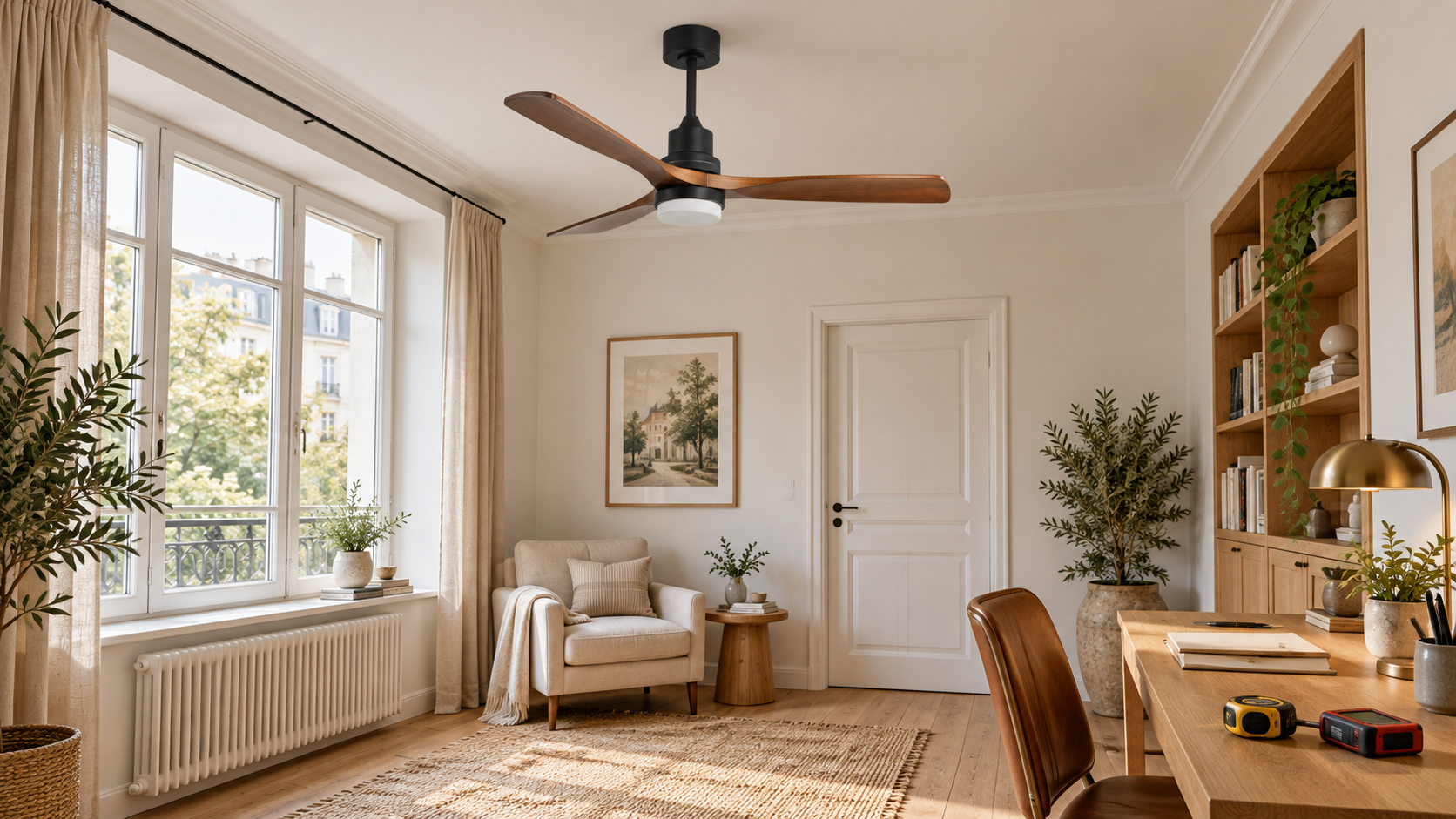
Remote, timer, reverse and smart controls can serve different needs, so confirm which functions are available through each control method.
For covered outdoor areas, also verify the manufacturer’s location approval and suitable IP rating. Blade material alone does not establish outdoor suitability.
Before ordering: confirm room area, blade diameter, airflow, installed height and clearances. Then check lighting, controls and comfort functions against how you will use the room.